Sunday, 26 April 2015

CH 12 - Electricity


Q1: What type of charge does an ebonite rod acquire when it is rubbed with wool? What is
the nature of the charge acquired by wool?


Answer: Ebonite rod has negative charge and woollen cap has equal amount of positive charge.


Q2: What is the charge on an electron (e)?

Answer: -1.6 x 10 -19 Coulombs (C)


Q3: Define Coulomb's law.

Answer: The magnitude of the force of attraction (or repulsion) between two point charges is
directly proportional to the quantity of charge present on each of them and inversely
proportional to the square of the distance separating them.

Let q1 and q2 be two like charges separated by a distance d, then the two charges will continue to repel each other with a force (F). Mathematically it is represented as:


Q4: What is the SI unit of charge? Is it a scalar or vector quantity?
Answer: SI unit of charge is Coulomb (C). It is a scalar quantity.


Q5: Define 1C or one coulomb.

Answer: 1C charge is the charge which when placed at a distance of 1 m from an equal like charge in vacuum, experiences a repulsive force on 1N.

Q6: How many electrons make one coulomb?

Answer:
Let us assume, n number of electrons constitute 1C.

Charge on 1 electron = -1.6 x 10 -19 C
∴ total charge Q = 1C = n x |e|
i.e. n = Q/|e| = 1/ 1.6 x 10 -19= 6.25 x 10 18 electrons        ...(answer)


Q7: What are the fundamental laws of Electrostatics?

Answer:
  • There are two types of charges namely positive and negative.
  • Like charges repel each other and unlike charges attract each other.

Q8: Define current

Answer: The rate at which charges move in a conductor is called electric current i.e. quantity of charges crossing a point in unit time.
I = q/t
where I is current in amperes (A)
q is total charge in Coulombs (C)
t - denotes time in seconds (s).

∴  1 A = 1 C/s

Q9: Is Ampere scalar or vector?

Answer: scalar


Q10: Two objects, with charges are 1.0 and 1.0 C, are separated by 1.0 km. Find the magnitude of the attractive force that either charge exerts on the other.

Answer: Given q1 = 1.0 C, q2 = 1.0 C, distance d = 1.0 km = 1.0 x 10³ m
Applying coulomb's law,

F = (9 x 109 x 1.0 x 1.0) / (1.0 x 10³ ) = 9 x 10³ N


Q11: Define Electric Potential.

Answer: It is  the work done in carrying a unit positive charge from infinity to that point against any electric field. it is denoted by symbol V. Its SI unit is volt.
i.e. V = W/ q

Q12: Define electric potential difference.

Answer: When a unit charge ( = 1 C) is carried from one point to another point, the work done is called potential difference.
E.g. potential difference between A and B is:

VAB = W  (Work done to carry charge q from A to B)  ÷ q (Charge in Coulombs)

The SI unit of potential difference is Volt (V).
1 Volt = 1 Joule / 1C

Q13: How many electrons per second pass though a given point in a wire carrying 2.0 Amps?

Answer:
Given Current (I) = 2.0 A
Time t = 1.0 s
I = q/t  ∴ q = I x t = (2.0)(1.0) = 2.0 C
Since Q = n x e (where n is number of electrons and e = 1.6 x 10 -19 C)
∴  n = 2.0 ÷  1.6 x 10 -19= 1.25 x 10 19            ...(Answer)

Q14: A charge of 2C moves between two plates, maintained at a potential difference of 1V. What is the energy acquired by the charge?

Answer:
Given Potential Difference (V) = 1V
Charge (q) = 2 C
W=qV=2×1=2J             ...(Answer)


Q15(NCERT): Name a device that helps to maintain a potential difference across a conductor.

Answer:  Cell, battery, power supply, etc.


Q16: Define electric circuit. Will the electric current flow in 
(a) an open circuit
(b) a closed circuit

Answer: A continuous and closed path of an electric current is called an electric circuit.

(a) Open Electric Circuit:  In an open electric circuit, the electric current does not flow as there is
some break in the path, i.e., either the key is open or some other end is not connected.

(b) Closed electric circuit. In this an electric current flows as the path is closed.


Q17: A current of 0.75 A is drawn by a filament of an electric bulb for 5 minutes. Find the amount of electric charge that flows through the circuit.

Answer: Given, Current (I) = 0.75 A
duration (t) = 5 min = 5 x 60s = 300 secs

Since, Q = I x t = 0.75 x 300 = 225 C ... (answer)


Q18: How much work is done in moving a charge of 5 C across two points having a potential difference 20 V?

Answer:
Given here,
                         Charge (q) = 5 C
    Potential Difference (V) = 20 V
    Work done in moving a charge W = qV = 5 x 20 = 100 J  ... (answer)


Q19: Define resistance. What is the SI unit of resistance?

Answer: Resistance is a property that resists the flow of electrons in a conductor. It controls the magnitude of the current. The SI unit of resistance is ohm (Ω).


Q20: To make an uncharged object have a negative charge we must:
a. add some atoms
b. remove some atoms
c. add some electrons
d. remove some electrons


Choose the appropriate option.

Answer: (c) add some electrons.


Q21: State Ohm's law.

Answer: Under similar physical conditions and at constant temperature, the current flowing through a wire is directly proportional to the potential difference applied across its ends.

 ⇒ I ∝ V               (where I is current and V is potential difference)
⇒  V/I = constant = R (where R is the resistance offered.)
⇒ V = IR
⇒ R = 1Ω = 1V/1A

Graphically it can be shown as:
Ohm's law is applicable to metallic conductors only.

 
Q22: What factors affect the resistance?

Answer: Resistance of the conducting wire depends on:
  • Nature of material (called resistivity ρ)
  • directly proportional to the length of the wire (l) i.e. R ∝ l
  • inversely  proportional to the cross sectional area of the wire (A)  i.e. R ∝l/A
  • varies with temperature.
Mathematically,  for metal conductors at fixed temp.
       R =  ρl/A


Q23: What is dangerous "High Voltage" or "High Current"?

Answer: It is high level of current is dangerous. A current of 1mA (milli Ampere) gives you a tingling effect. Current above 10mA is painful. Current of value 12-20mA can paralyze muscles and current above 100mA can collapse the heart.
You might have seen 'Van de Graaf generator' at Science Museum (see figure below: source: http://www.mtu.edu/news/images/2010/image29764-horiz.jpg)
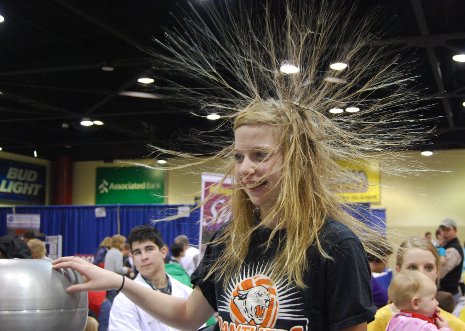
Van de Graaf Generator (source: Michigan Tech University)
The Van de Graaf generator creates thousands of volts but current is less than 1mA (enough to tingle and raise you hair).
You may have seen 'High Voltage' sign boards near transformers, Metro Stations.
Generally the wires carrying high voltage at these places do carry high current (greater than 1 Amperes) which can produce lethal effects on your body.


Q24: If R1 is 20 Ω, and R2 is 40 Ω, what is the current flowing in the circuit if the two resistors are connected in series. The battery connect is 6.0 V?

Answer: When resistors are connected in series, effective resistance Req = R1 + R2
i.e. Req = 20 + 40 = 60 Ω
Applying Ohm's law,
I = V/Req = 6 / 60 = 0.1 A             ...(answer)


Q25: What is current resistance in each resistor  for a parallel combination of 3.0 Ω, 3.5 Ω and 4.0 Ω resistors. The battery connected is of 8V. Also find the effective resistance and effective current.
Answer:

Q26: Why an ammeter will burn out if connected in parallel in an electric circuit?

Answer: Ammeter has very low resistance. If connected in parallel, a large current will draw, may be enough to burn it up.

Q27: Name the instrument used to change the resistance of the circuit.

Answer: Rheostat.

Q28: A cylindrical wire has a radius R and length L. If both R and L are doubled, the resistance of the wire 
(a) increases
(b) decreases
(c) remains the same.

Answer: (b) decreases.
(Hint: Use equation R =  ρl/A, A will be come 4 times).

Q29: Find the equivalent resistance for the following circuit when

(a) Switch is closed.
(b) Switch is open.

Answer: Given, R1 = 10Ω, R2 = 5Ω,  R3= 5Ω and R4 = 10Ω
Case a: When switch is closed. R1 and R3 will be in parallel. Similarly R2 and R4 are in parallel (as the following figure shows). 
These two parallel resistors are in series. i.e. (R1 || R3) + (R2 || R4).
i.e. 1/R13 = 1/R1 + 1/R3 = 1/10 + 1/5 = 3/10 ⇒ R13 = 10/3 Ω
Similarly R24 = 10/3 Ω

R(eqv.) = R13 + R24 = 10/3 + 10/3 = 20/3 Ω  ...(answer)

Case b: When switch is open, as shown in below figure, R1 and R2 will be series. Similarly, R3 and R4 will be series. And these two series circuits are connected in parallel to each other.
∴ R12 = R1 + R2 = 10 + 5 = 15Ω
Also R34 = R3 + R4 = 5 + 10 = 15Ω

1/R(eqv.)  = 1/R12 + 1/R34 = 1/15 + 1/15 = 2/15 Ω
R(eqv) = 15/2 Ω = 7.5 Ω ...(answer)

Q30(): Consider the following circuit consisting of infinite resistors of value R. Compute the equivalent resistance RAB between A and B.
Answer: No doubt the problem is beyond CBSE syllabus :)
However, If the same problem is represented in equation form (Class 10 Maths - Quadratic Equations, recurring rational numbers), you can easily solve this.

Let RAB be the equivalent resistance. If we chop the first two resistors R, still the remaining circuit represents  RAB
The circuit can be represented as:
 Let us assume R = x.


Q 31: State True or False
(a) Current gets divided in series combination.
(b) 1 Watt = 1 Volt / 1 Ampere
(c) Tungsten is used for making bulb elements.
(d) The graph between V and I for metals is a curve.
(e) Insulators have high resistivity and negligible conductivities.
(f) Metals and alloys have low resistivity in the range of 10-8 Ωm to 10-16Ωm.

Answer:
(a) False
(b) False
(c) True
(d) False
(e) True
(f) True


Q32: Why is the series arrangement not used for domestic circuits?

Answer: Series arrangement is not used for domestic circuits because of the following reasons:
  • If one appliance gets fused, it will break the circuit and all other appliances will stop working.
  • In series, the voltage drops at each appliance. No appliance would be working at required voltage.

Q33: Why are alloys commonly used in electrical heating devices?

Answer:
  • Alloys have high resistivity.
  • They do not oxidize easily.

Q34: Why are bulbs filled with chemically inactive Nitrogen or Argon gas.

Answer: It is done in order to prevent oxidation of Tungsten filament.


Q35: State thermal effect of electricity.

Answer: When current is passed through a conductor it gets heated up. It is called thermal effect.
If heat produced is H joules, then
   H α potential difference (V),
   H α current flowing
   H α duration (time) the current flows.

   H α VIt or H = kVIt

Taking k = 1, V = 1 volt, I = 1A and t = 1 second, H = 1J.

H = VIt
Applying Ohm's law (V = IR),

H = VIt = I2Rt = V2t/R

H =  I2Rt is also known as Joule's law of heating.

 
Q36: A potential difference of 250V is applied across a resistance of 1000 ohm. Calculate the heat energy produced in the resistance in 10 s.

Answer: Given V = 250 volts, R = 1000 Ω t = 10s
H = V2t/R = 250 x 250 x 10/1000 = 625 J ... (answer)


Q37: Judge the equivalent resistance when the following are connected in parallel
(a) 1 Ω and 106 Ω,
(b) 1 Ω and 103 Ω, and 106 Ω.

Answer:
(a) 1 Ω and 106 Ω connected in parallel
1/R = 1/1 + 1/106
⇒ R = 106/(106+ 1)  ≈ 106/106 = 1 Ω.         ...(answer)

(b) 1 Ω and 103 Ω, and 106 Ω. connected in parallel.
1/R = 1/1 + 1/103 + 1/106
⇒ R = 106/(106+ 103 +1)  = 106/1001001 = 0.99900 Ω  ... (answer)

Q38: Will current flow more easily through a thick wire or a thin wire of the same material, when connected to the same source? Why?

Answer
Since Resistance(R) is inversely  proportional to the cross sectional area of the wire (A)  i.e. R ∝l/A. Thicker the wire, lesser will be the resistance. Therefore, current will flow more easily in a thick wire as compared to a thin wire of same material and length.

Q39: An electric iron has a rating of 750W, 220V. Calculate
(i) current passing through it, and
(ii) its resistance, when in use

Answer: Given,
   Power(P) = 750W
   V = 220 volts
   P = VI  ⇒ I = P / V = 750 / 220 = 3.4 A   ...(answer)
   R = V/I = 220/3.4 = 64.7Ω  ...(answer)

Since the resistance of the conductor is inversely proportional to its area of cross-section. Therefore thicker wire will draw more current and resistance will be less.

Q40: What is the commercial unit for electrical energy?

Answer: Killowatt hour (KWh) is the commercial unit for electrical energy.
              1 KWh = 1000 W hour -= 1000 Joules/second x 3600 second
               i.e.      = 3.6 x 10⁶ Joule.

Q41 (CBSE): In a household, an electric bulb of 100W is used for 10 hours and an electric heater of 1000W is used for 2 hours. Calculate the cost of using bulb and the heater for 30 days. Take the cost of one unit of electrical energy as 2 rupees.

Answer:  Energy Consumed = Power x time
∴ Energy consumed in 30 days will be
                 = energy consumed by bulb (E1) + energy consumed by heater (E2)
     E1 = 100 x 10 x 30 = 30000 Wh = 30KWh
     E2 = 1000 x 2 x 30 = 60000 Wh = 60KWh

Total energy consumed = 30 + 60 = 90KWh
Cost of electrical energy = 2 x 90 = INR 180           ...(answer)


Q42: An electric fuse used in households, works  on which principle?

Answer:  Electric fuse works on the principle of Joule’s heating.

Q43: How does electric fuse works?

Answer: Electric fuse works on the principle of Joule’s heating. It protects circuits and appliances by stopping the flow of any unduly high electric current. The fuse is placed in series with the device. It consists of a piece of wire made of a metal or an alloy of appropriate melting point, for example aluminium, copper, iron, lead etc. If a current larger than the specified value flows through the circuit,
the temperature of the fuse wire increases. This melts the fuse wire and breaks the circuit.

Q44: How electric fuse is connected with electrical devices i.e. in parallel or in series?

Answer: In series.


Q45: Which type of material is commonly used for fuse wire?

Answer: It consists of a piece of wire made of a metal or an alloy of appropriate melting point, for example aluminium, copper, iron, lead etc.


Q46: Why is electric power transmitted over long distances at high voltage?

Answer:  It is done to minimize power losses due to Joule's heating. We know that Power = V ✕ I and Heat generated  = I2Rt. Thus by keeping low current, heating effect is reduced and high voltage retains the total power.

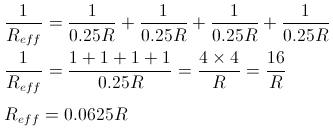
Q47(CBSE):  A piece of wire having resistance R is cut into four equal parts.

a. How does the resistance of each part compare with the original resistance?

b. If the four parts are placed in parallel, how will the resistance of combination compare
with the resistance of original wire?


Answer: (a) Since R ∝ length of wire. Decrease in length will reduce the resistance. Each piece will have resistance = R/4Ω = 0.25RΩ

(b) In parallel, the effective resistance will be R/16Ω


Q48(CBSE 2011): Why do the wires connecting an electric heater to the mains not glow while its heating element does?

Answer: The heating element of an electric heater is a high value resistor. The amount of heat produced by it is proportional to its resistance. The resistance of the element of an electric heater is very high. As current flows through the heating element, it becomes too hot and glows red. On the other hand, the resistance of the cord (wire connecting heater to mains) is low. It does not oppose the flow of current and hence it does not become red when current flows through it.


Q49: Electrical resistivity of some substances at 20°C are given below:
         Silver = 1.60 × 10⁻⁸ Ω m
     Mercury = 94.0 × 10⁻⁸ Ω m
      Ebonite = 1015 - 1017 Ω m
(i)  Which among the above three is a better conductor?
(ii) Which among the above three can be used for making electrical plugs?

Answer: (i) Silver has the lowest resistivity, it is a better conductor.
(ii) Ebonite has very high resistivity. It can be used to make electric plugs.


Q50: What will be the length of a Nichrome wire of resistance 5.0 Ω, if the length of similar wire of 120 cm has resistance of 2.5 Ω?

Answer: Since Resistance is directly proportional to the length of the wire i.e. R ∝l
⇒ R1/l1 = R2/l2
Given  R1= 5 Ω,    l1 = ?
R2= 2.5 Ω,    l2 = 120 cm
⇒ l1 = R1× l2/R2 = 5 × 120/2.5 = 240 cm

N.C.E.R.T Solutions Ch - Electricity

When a 12 V battery is connected across an unknown resistor, there is a current of 2.5 mA in the circuit. Find the value of the resistance of the resistor.
Answer: Given, Potential difference, V = 12 V
Current (I) across the resistor = 2.5mA = 2.5 x 10 -3 = 0.0025 A
Resistance, R =?
We know, R = V/I = 12 V ÷ 0.0025 A = 4800

  • A piece of wire of resistance R is cut into five equal parts. These parts are then connected in parallel. If the equivalent resistance of this combination is R′, then the ratio R/R′ is
    • 1/25
    • 1/5
    • 5
    • 25

      Answer: (d) 25 Explanation: The piece of wire having resistance equal to R is cut into five equal parts. Therefore, resistance of each part would be R/5.
      When all parts are connected in parallel, the resistance of total resistance can be given as follows:
      1/R' = 5 x (5/R) = 25/R
      Or, R/R' = 25
  • Which of the following terms does not represent electrical power in a circuit?
    • I2R
    • IR2
    • VI
    • V2/R

      Answer: (b) IR2 Explanation: We know that Power (P) = VI
      After substituting the value of V = IR in this we get
      P = (IR) I = I x R x I = I2R, Thus P = I2R
  • An electric bulb is rated 220 V and 100 W. When it is operated on 110 V, the power consumed will be
    • 100 W
    • 75 W
    • 50 W
    • 25 W

      Answer: (d) 25 W Explanation: Potential difference, V = 220 V, Power, P = 100 W
      Therefore, power consumption at 100 V =?
      To solve this problem, first of all resistance of the bulb is to be calculated.
      We know that P = V2 ÷ R
      Or, 100 W = (220 V)2 ÷ R
      Or, R = 48400 ÷ 100 = 484 Ω
      Now, when the bulb is operated at 110 V, then power can be calculated as follows:
      P = 1102 ÷ 484 = 12100 ÷ 484 = 25 W
      Thus, bulb will consume power of 25W at 110V
  • Two conducting wires of the same material and of equal lengths and equal diameters are first connected in series and then parallel in a circuit across the same potential difference. The ratio of heat produced in series and parallel combinations would be
    • 1:2
    • 2:1
    • 1:4
    • 4:1

      Answer: (d) 4 : 1 Explanation: Let the potential difference = V,
      Resistance of the wire = R
      Resistance when the given wires connected in series = Rs
      Resistance when the given wires connected in parallel = Rp
      Heat produced when the given wires connected in series = Hs
      Heat produced when the given wires connected in parallel = Hp
      Thus, resistance Rs when the given two wires connected in series = R + R = 2R
      Resistance Rp when the wires are connected in parallel can be calculated as follows:
      1/Rp = 1/R + 1/R = 2/R
      Or, Rp = R/2
      We know, heat produced H = I2R t
      Ratio of heat produced in two conditions:
      Hs : Hp = 2R ÷ R/2 = 4 : 1
  • How is a voltmeter connected in the circuit to measure the potential difference between two points?

    Answer: Voltmeter is connected into parallel to measure the potential difference between two points in a circuit.
    connection of voltmeter

  • A copper wire has diameter 0.5 mm and resistivity of 1.6 × 10⁻⁸ Ω m. What will be the length of this wire to make its resistance 10 Ω? How much does the resistance change if the diameter is doubled?

  • Answer: Given, Diameter of wire = 0.5 mm Hence, radius = 0.25 mm = 0.00025 m
    Resistivity, ρ = 1.6 x 10⁻⁸ Ω m
    Resistance (R) = 10 Ω and length = ?
    Resistance (R1) when diameter is doubled = ?
    We know;
    numerical problem solution
    When diameter is doubled, radius becomes 0.0005 m
    numerical problem solution
  • The values of current I flowing in a given resistor for the corresponding values of potential difference V across the resistor are given below
    data for question
    Plot a graph between V and I and calculate the resistance of that resistor.


    Answer: The slope of the graph will give the value of resistance.
    voltage current graph
    Let us consider two points A and B on the slope.
    Draw two lines from B along X-axis and from A along Y-axis, which meets at point C
    Now, BC = 10.2 V – 3.4 V = 6.8 V
    AC = 3 – 1 = 2 ampere
    numerical problem solution
  • When a 12 V battery is connected across an unknown resistor, there is a current of 2.5 mA in the circuit. Find the value of the resistance of the resistor.

    Answer: Given, Potential difference, V = 12 V Current (I) across the resistor = 2.5mA = 2.5 x 10 -3 = 0.0025 A
    Resistance, R =?
    We know; R = V/I
    = 12 V ÷ 0.0025 A = 4800 Ω
  • A battery of 9 V is connected in series with resistors of 0.2 Ω, 0.3 Ω, 0.4 Ω , 0.5 Ω and 12 Ω, respectively. How much current would flow through the 12 Ω resistor?

    Answer: Given, potential difference, V = 9 V Resistance of resistors which are connected in series = 0.2 Ω, 0.3 Ω, 0.4 Ω , 0.5 Ω and 12 Ω respectively
    Current through resistor having resistance equal to 12Ω =?
    Total effective resistance, R = 0.2 Ω + 0.3 Ω + 0.4 Ω + 0.5 Ω + 12 Ω = 13.4 Ω
    We know; I = V/R
    = 9 V ÷ 13.4 Ω = 0.671 A
    Since, there is no division of electric current, in the circuit if resistors are connected in series, thus, resistance through the resistor having resistance equal to 12 Ω = 0.671 A

Saturday, 25 April 2015

LIFE PROCESSES IMPORTANT QUESTON ANSWERS


1 MARKS QUESTIONS 
1. A farmer floods his field everyday thinking that watering in this manner will result a better yield of his wheat crop. What will be the result of this action of the farmer. 
Ans.This will result in water logging of the soil due to which roots cannot breathe and ultimately plants will die .
2. Name the term for transport of food from leaves to other parts of plants.
Ans.Translocation
3. Which pancreatic enzyme is effective in digesting proteins? 
Ans.Trypsin
4. Which enzyme is present in saliva breaks down starch? 
Ans.Salivary amylase.
5. After a vigorous exercise you may experience cramps in your leg muscles. Why does this happen? 
Ans.Accumulation of lactic acid
6. Name the organelle in which photosynthesis occurs. 
Ans.Chloroplast.
7. Name the type of blood vessels which carry blood from organs to the heart. 
Ans.Veins.

8. Name the respiratory structures of i.Mosquito ii)earth worm.

Ans.i) mosquito—System of air tubes. ii)earth worm—moist skin.
9. Write the two functions of kidneys. 
Ans. Osmoregulation and excretion.

10. What are spiracles.

Ans The holes found on the lateral side of insect‘s body.

2 MARKS QUESTIONS 
1. Differentiate autotrophs and heterotrophs.
Ans.The organism which prepare their own food are called autotrophs for eg: green plants .

 The organisms which depend on the food prepared by other organisms are called heterotrophs for eg: animals
2.Differentiate between aerobic respiration and anaerobic respiratrion. 
Ans.   Aerobic respiration                                            
1. It occurs in the presence of oxygen              .

2. Glucose is completely broken down to carbondioxide and water.

3. More energy is released 38 ATP. 
Anaerobic respiration
1 .It occurs in the absence of oxygen
2. Glucose is incompletely oxidised to ethanol or lactic acid
3. Less energy is produced 2ATP
3. Explain the role of the following in the process of digestion in the human body
A) saliva

B) trypsin

a) saliva-

a) Saliva contains an enzyme salivary amylase which digests starch

b) trypsin.-helps in digestion of proteins.
4. What is double circulation.? 
Ans..In double circulation blood goes through the heart twice during each cycle in vertebrates.

5 Write any two points of difference between respiration in plants and respiration in animals.

Respiration in plants.


1.In plants separate respiratory organs are absent
2.The rate of respiration is slow.
3.They lack respiratory surface 
Respiration in animals 
1.In animals respiratory organs are generally present 
2.The rate of respiration is fast.

3. Respiratory surface is generally present. 

6. Differentiate Holozoic nutrition and saprophytic nutrition.

Holozoic nutrition
In this nutrition organisms derive their food by consuming complex organic materials by the process of ingestion and then converting the complex  molecules into simpler ones to  obtain nutrients. Eg. animals and human beings. 
Saprophytic nutrition
In this type of nutrition organism derive their food from the dead and decaying materials. Eg.fungi
7. Why do veins have thin walls compared to arteries?
Ans: Veins do not have thick walls because blood is no longer under pressure but blood emerges from the heart under high pressure. So arteries have thick walls
8. Where do the plants get each of the raw materials? 
(a) CO2                  (b) water                            (c) minerals

Ans.
(a) CO2- from air,                 (b)water-from soil      (c)minerals-from soil along with water.

9. What do the following transport?

 a)xylem and  phloem   c)pulmonary vein        d) venacava

Ans.

a) xylem-water and minerals

b) phloem- prepared food.

c) Pulmonary vein-oxygenated blood

d) vena cava -deoxygenated blood
10. Write one function each of the following components of transport system in human beings. a)arteries  b) veins c)capillaries 
ans:

a) arteries- carry blood from heart to different parts of body

 b) veins-carry blood from different parts of body to the heart.

c) Capillaries-exchange of material between blood and surrounding cells.
11. a) How is fat digested in our body? b) Where does this take place? 
Ans.

A) fats are emulsified by bile salts. The emulsified fats are acted upon by pancreatic and intestinal lipase to form fatty acids and glycerol.

b) digestion of fats occurs in small intestine.

3 MARKS QUESTIONS


 1. What is the function of epiglottis in man? Draw a labeled diagram showing the human respiratory system. 
Epiglottis. It is an adjustable flap of fibro cartilage that covers glottis when food is being swallowed.  Diagram of human reaspiratory system. Fig 6.9 (NCERT text book page no.104.)

3. What is known as double circulation Briefly explain the process .

Ans.It is passage of the same blood twice through the heart first on the right side, then on the left side in order to complete one cycle. It has two components ,pulmonary circulation and systemic circulation. Hint. pulmonary circulation and systemic circulation 4.How water is transported upwards in plants? Hint. Transpiration pull
5. Name the tissue that transports the prepared food in plants . Explain the mechanism of transport of food in plants. 
Ans.: phloem  Hint: translocation using energy from ATP. 6Briefly describe the excretory system in human beings. Hint a pair of kidneys a pair of ureters,a urinary bladder and a urethra.

7.Describe the functioning of nephrons.

 Hint: filteration, reabsorbtion, secretion
8.What are the differences between the transport of materials in xylem and phloem hint transport in xylem:
water transport using transpirational pull Transport in phloem: food, transport using energy from ATP
9. Draw and label the sectional view of the human heart.
Diagram NCERT text book fig 6.10 page 106
10. dfifferentiate between osmoregulation and excretion excretion is the elimination of metabolic waste products from the body. 
Osmoregulation is regulating osmotic pressure of the body fluids by controlling the amount of water and salts in the body

5 MARKS QUESTIONS 

1. Write the process of digestion.

Digestion in mouth,stomach, duodenum,digestion in jejunum . Digestion of carbohydrates, digestion of proteins, digestion of fats

2.Which chamber of human heart receives oxygenated blood? Explain how oxygenated blood from this chamber is sent to all parts of the body.

Ans Left atrium

 Hint. Explanation of systemic circulation

3.Draw the diagram of cross section of a leaf and label the following in it. 
A) Chloroplast b)guard cell c)lower epidermis d)upper epidermis 
Name the two stages in photosynthesis. 
Ans Draw fig 6.1 NCERT text book page 96 Two stages light reaction and dark reaction

4.Draw a neat diagram of the human respiratory system and label the parts.

 b)How are the alveoli designed to maximize the exchange of gases. Suggest any two features.

Draw fig6.9 and explain the structure and function of alveoli
5.a) Draw a diagram of human alimentary canal.
 b) label the following on the diagram Esophagus, liver gall bladder, duodenum
c)What is the function of liver in human body 

ans. : Draw fig 6.6 in page 99 of NCERT and label the parts mentioned. Liver. Secretes bile that emulsifies fats . Bile provide alkaline medium for digestion of proteins.


v  Life processes – The processes that are necessary for an organism to stay alive. Eg. Nutrition, respiration, etc.
v  Criteria of life- (i) Growth  (ii) Movement
v  Nutrition- The process in which an organism takes in food, utilizes it to get energy, for growth, repair and maintenance, etc. and excretes the waste materials from the body.
v  Types of nutrition                                                                           
1.      Autotrophic nutrition(Auto =self:  trophos = nourishment) E.g. Plants, Algae, blue green bacteria.
o   Process – Photosynthesis(Photo=light; Synthesis= to combine)
o   Raw materials- (i) Carbon dioxide (ii)Water
o   Equation-                  sunlight                                                                         
o    6CO2  +  6H2O                          C6H12O6      +     6O2
                                     Chlorophyll
o   Energy conversion- Light/Solar energy to Chemical energy
o   Role off Chlorophyll- To trap the sun’s energy for photosynthesis
o   Factors- (i) Carbon dioxide (ii) Water(iii)  Light (iv)  Temperature
o   Events/ Steps of photosynthesis-    
(i)       Absorption of light energy by chlorophyll
(ii)      Conversion of light energy to chemical energy & Splitting of water molecule into Hydrogen & oxygen
(iii)   Reduction of Carbon dioxide to Carbohydrate
o   Gaseous exchange- (i) Gas used- Carbon dioxide 
                                     (ii)  By product - Oxygen
o   Source of raw materials-
(i)         Carbon dioxide –Land plants- Air, Aquatic plants- Water
(ii)      Water & Minerals - Soil

2.      Heterotrophic nutrition (Hetero =others:  trophos = nourishment) Eg. Animals, plants lacking chlorophyll like fungi.
(a)    Saprophytic nutrition: Organisms feeds on dead decaying plants or animals material. E.g. Fungi, Bacteria

(b) Parasitic nutrition: Organisms obtain food from the body of another living (host)
o   Endoparasite : Parasite lives inside the body of the host e.g. tapeworm, roundworm.
o   Exoparasite:  Parasite lives on the body of the host. E.g. lice, leech.
 Note- The parasite benefits while the host is usually harmed e.g. Cuscutta-plant parasite (amar bel), plasmodium (malarial parasite).

 (c) Holozoic nutrition: Organism (mostly animals) take in whole food and then digest it into smaller particles with enzyme. Eg. Amoeba, Paramoecium. Animals, human beings.
o   Steps in Holozoic nutrition
(i)                 Ingestion: taking in of food.
(ii)               Digestion: breaking down of complex food into simpler, absorbable form.
(iii)             Assimilation: Utilization of digested food from the body.
(iv)             Egestion: Removing undigested food from the body          


o   Nutrition in human beings
§  Alimentary canal-  
           Mouth → Oesophagus → Stomach → Small intestine  → Large intestine
§  Important gland/juices
         (Refer to figure 6.6 page no.97 of N.C.E.R.T  Text book)

Organ
Gland
Enzyme/Juice
Function

Mouth
Salivary glands
Salivary Amylase
Converts starch into sugar
Stomach
Gastric glands
Gastric juice-
(i) Hydrochloric
     acid                →


(ii)  Pepsin         →
(iii) Mucus        →

(a) Kills harmful bacteria that
     enters with the food.
(b)   Makes the medium alkaline
      for the action of Pepsin
Digests proteins
Protects the inner lining of the stomach from the corrosive action of Hydrochloric acid.         
Small intestine
1) Liver


2)   Pancreas  
(i) Bile juice      →


(ii)  Pancreatic
      Juice        
  • Amylase →
  • Trypsin   →
  • Lipase     →


(a) Makes the medium acidic
      for the action of Pancreatic
     enzymes.
(b) Breaks down large fat
     molecules into smaller globules
     so that enzymes can act upon
     them.


Converts Carbohydrates to glucose
Converts Proteins to Amino acids
Converts Fats into Fatty acids & Glycerol

§  Peristaltic movements- Rhythmic contraction of muscles of the lining of Alimentary canal to push the food forward.
§  Sphincter muscle- Helps in the exit of food from the stomach.

§  Villi- Small finger like projections on the walls of-
(v)               Small intestine- To increase the surface area for the absorption of food.
(vi)             Large intestine- For absorption of water.


v  Respiration- The process by which digested food is broken down with the help of Oxygen to release energy.

o   Types of  respiration- (i) Aerobic respiration  (ii)Anaerobic respiration 

Aerobic respiration

Anaerobic respiration 
1.  Takes place in presence of Oxygen.

2.  End products- Carbon dioxide & Water

3. More energy is released.

4.  Takes place in Cytoplasm & Mitochondria

5. Complete oxidation of glucose takes place.

6. It occurs in most organisms.


7.  Equation-
Glucose→ Pyruvate→ CO2  +  H2O + Energy
1.  Takes place in absence of Oxygen.

2. End products- Ethanol & Carbon dioxide

3. Less energy is released.

4.  Takes place in only in Cytoplasm.

5. Incomplete oxidation of glucose takes place.

6.  It occurs in certain bacteria, yeast & certain tissues of higher organisms. E.g. In humans during vigorous exercise, when the demand for Oxygen is more than the supply, muscle cells respire anaerobically for some time.

7.  Equation-
In Yeast-
Glucose→ Pyruvate→ Ethanol + H2O + Energy
In muscle cells -
Glucose→ Pyruvate→ Lactic acid + Energy

  • Some common features of Respiratory organs-                                                                            (i) Large surface area- for greater rate of diffusion of respiratory gases.                                   (ii)  Thin permeable walls – to ensure easy diffusion & exchange of gases.                              (iii)  Extensive blood supply- Respiratory organs are richly supplied with blood vessels for quick transport of gases.
  • Gaseous exchange in plants-  
    • Process – Diffusion
    • Direction of diffusion depends on- (i) Environmental conditions
                                                              (ii)  Requirement of the plant.
§  Day time- Carbon dioxide given out during respiration is used for photosynthesis. Therefore only Oxygen is released, which is a major activity during the day.
§  Night time – Only respiration takes place. Therefore only Carbon dioxide is released, which is a major activity during the night.

  •  Gaseous exchange in animals-      
§  Terrestrial animals- take Oxygen from the atmosphere.
§  Aquatic animals- take Oxygen dissolved in water. (Oxygen content is low in water, therefore they breathe faster.
  • Human Respiratory system-                                                                                                External nostrils → Nasal cavity → Trachea→ Bronchi → Bronchioles →Alveoli
§  Rings of cartilage present in the throat ensure that the trachea (air passage) does not collapse when there is less air in it.
§  Lungs – (i) Present in the thoracic cavity.                                                           
                    (ii)  They are spongy, elastic bags consisting of Bronchi,
                                             Bronchioles and Alveoli
                               Refer to figure 6.9 page no. 104 of N.C.E.R.T  Text book)
  • Respiration occurs in two phases-
  • (i) External-Breathing, which is a mechanical process.                                                               (ii) Internal - Cellular respiration
  • Mechanism of breathing – It includes : (i)Inhalation   (ii) Exhalation
  • Exchange of gases-
§  Unicellular organisms- By Diffusion
§  Animals- (i) As the body size is large, diffusion alone is not enough.
                      (ii)  Respiratory pigments also required.
                      (iii) Respiratory pigment in human beings is Haemoglobin,
                             which is present in red blood corpuscles.
                       (iv) It has very high affinity for Oxygen.
                       (iv) Carbon dioxide is more soluble in water thanOxygen, so it
                               Gets dissolves in blood and is thus transported.
v  Transportation
  • Transportation in human beings-
§  Blood- (i) It is a fluid connective tissue.
    (ii) Components- (1) Fluid medium- Plasma
                                                         (2)  Red blood corpuscles
                                                         (3)  White blood corpuscles
                                                         (4)  Platelets suspended in plasma
                             (iii)  Plasma transports food, Oxygen, Carbon dioxide,
                                                  Nitrogenous wastes, etc.
§  Functions of blood- (i) Transport of respiratory gases.
                         (ii) Transport of nutrients.
                         (iii) Transport of waste products.
                         (iv)  Defence against infection
§  Blood vessels- (i) Arteries (ii) Veins (iii) Capillaries
                          Arteries
                        Veins
1.  Thick walled.
2.  Deep seated.
3.  Carry blood away from the heart.
4.  Carry Oxygenated blood.
5.  Valves absent.
1.  Thin walled.
2.  Superficial. 
3.  Carry blood to the heart.
4. Carry Deoxygenated blood.
5.  Valves present

§  Heart-    (Refer to figure 6.10 page no. 106 of N.C.E.R.T  Text book)
      (i) It is a muscular organ, which works as a pump in the circulatory system.
                       (ii)  It is the size of our fist.
                       (iii)  It has two sides, which are separated by a partition so that the oxygenated and
                              deoxygenated blood do not get mixed up.
                       (iv) It has four chambers-
        Two upper chambers called Atria. 
        Two lower chambers called Ventricles.    
§  Working of heart-
Left side- (i)  Left atrium relaxes & the Oxygenated blood enters it from
                                               the lungs through the pulmonary vein.
  (ii)  Left atrium contracts & the blood enters the left ventricle
         through the valve.
  (iii) Left Ventricle contracts and the blood is pumped into the
           largest artery ‘Aorta’ and is carried to all parts of the body.
Right side- (i) Right atrium relaxes & the deoxygenated blood from the body enters it 
                                          through superior and inferior Vena cava.
      (ii)  Right atrium contracts & the blood enters the right Ventricle through
            the valve.
                                             (iii) Right Ventricle contracts and the blood is pumped into the Pulmonary
                                                    artery and is carried to lungs.
§  Valves- Unidirectional to prevent the backward flow of blood.
§  Pulmonary vein is the only vein that carries Oxygenated blood.
§  Aorta is the only artery that carries Deoxygenated blood.
§  Double circulation in man- because the blood passes through the heart twice in one complete cycle of the circulation.
§  Capillaries- (i) Form the connection between arteries & veins.
                                           (ii) Walls are one cell thick only for easy exchange of
                                                  blood.
§  Platelets- Plug the leaks of arteries and veins by clotting the blood.
§  Lymph- Extracellular fluid similar to plasma but colourless with lesser protein.
§  Function of lymph-  (i) Transportation of digested & absorbed fats from
                                            the small intestine.
                                       (ii)  Drains excess fluid from the intercellular spaces
                                              back in the blood.
§  Higher animals-  E.g., birds, mammals.                                                       
(i)                  Oxygenated blood & Deoxygenated blood are completely separate for efficient Oxygen supply.  
(ii)               This is  to fulfil higher energy needs and to maintain body temperature (warm blooded animals). 
§  Amphibians & reptiles- have 3 chambered heat where little mixing of  Oxygenated blood & Deoxygenated blood takes place. Therefore their body temperature varies with the temperature of the environment. (cold blooded animals)                                                                          
  • Transportation in plants-
§  Plants need less energy needs- because they do not move and therefore have a slow transport system
§  Transport of water- 
(i)                 Takes place by xylem tissue present in roots, stem, leaves and is therefore interconnected.
(ii)               Root cells take up ions from the soil, which creates a concentration difference between root and soil. Column of water therefore rises upwards.
§  In very tall plants- transpiration creates a suction pressure, which pulls the water upwards.
§  Importance of transpiration-
(i)                 Helps in upward movement of water in plants.
(ii)               It regulates the temperature in plants.   
                 §  Transport of food-
(i)                 Takes place by phloem tissue.
(ii)               Movement of prepared food in plants is called translocation.   
v  Excretion- The biological process of removal of harmful metabolic wastes in living organisms.
v  Excretion in human beings-
(Refer to figure 6.13 page no. 110 of N.C.E.R.T  Text book)
§  Organs of excretory system- (i) Kidneys        (iii) Urinary bladder
                                                    (ii) Ureters         (iv) Urethra
§  Kidneys-
(i)                 Two in number
(ii)               Bean shaped      
(iii)             Present in abdomen on either side of the backbone
(iv)             Basic unit is nephron.
a.       Glomerulus- Group of capillaries (cluster) present in Bowman’s                            capsule to receive blood from renal artery and filters it.
b.      Bowman’s capsule- Cup shaped structure, which contains glomerulus.
c.        Convoluted tubule-is long and reabsorbs vital nutrients like glucose, amino acids, salts, urea and water.

      Note-Vital functions of kidneys- (a) Filtration & removal of Nitrogenous wastes                                                                  
                                          (b)  Reabsorption of vital nutrients
§  Ureters- Transport the urine formed in the kidneys to the urinary bladder.
§  Urinary bladder- Muscular bag like structure to store urine.
§  Urethra- Helps in removal of urine when the Urinary bladder is full.
§  Artificial kidney- Principle: Dialysis
v  Excretion in plants-   
    • Gaseous wastes- CO2 in respiration & O2 in photosynthesis are removed by the process of diffusion.
    • Excess water- is removed by transpiration.
    • Other wastes- (i) Stored in cellular vacuoles or in leaves, which fall off or as gums, resins, etc. in old xylem.
                             (ii)  Excreted in soil.
v  Important diagrams-
1.      Open & close stomata
2.      Steps of nutrition in Amoeba
3.      Alimentary canal of human beings/ Digestive system of human beings
4.      Respiratory system of human beings
5.      Structure of heart.
6.      Excretory system of human beings
7.      Structure of nephron